Most foot pain conversations collapse into a single question: should I get better insoles, or should I do exercises? The framing makes it sound like one must be right and the other wrong. They are solving different problems, and sometimes the same foot needs both, in the right order.
What Arch Support Actually Does
Arch support works by redistributing load. When you stand or walk, the plantar fascia, a thick band of connective tissue running from the heel to the base of the toes, absorbs and transmits force with every step. An insole or a supportive shoe changes the angle at which that force arrives, reducing the mechanical stress on the fascia and the structures around it.
The relief is real and often immediate. That speed is also the limitation: the insole is doing the work the foot would otherwise do. The intrinsic muscles of the foot, the small muscles that sit inside the foot itself, rather than running down from the calf, get less stimulus. Over time, passive support can allow those muscles to weaken further, which means removing the support becomes harder, not easier. This is not a reason to avoid arch support. It is a reason to understand what you are buying: symptom management, not structural change.
Support is most defensible when the underlying tissue is acutely inflamed, plantar fasciitis in its early, painful phase; post-surgical recovery; a stress fracture that needs offloading. In these situations, reducing mechanical load is the priority. Asking an inflamed structure to strengthen before it has settled is counterproductive.
What Foot Strengthening Actually Does
The intrinsic foot muscles, including the flexor digitorum brevis, the abductor hallucis, and the lumbricals, maintain the arch dynamically during movement. Unlike the passive arch created by a rigid insole, the arch these muscles support changes shape in response to terrain and load. A foot with strong intrinsic muscles absorbs impact differently than one that relies on external structure.
Strengthening exercises, short-foot exercises, toe spreads, single-leg calf raises on varied surfaces, target this system. The evidence for these approaches in conditions like plantar fasciitis and flat-foot-related knee pain is reasonably consistent, though results take weeks to months, not days. Progress is also individual: someone with a structural deformity, a neurological condition affecting the lower limb, or significant tendon damage will respond differently than someone whose foot pain is primarily muscular.
The honest limitation of strengthening: it requires time, consistency, and correct technique. Done incorrectly, exercises can overload a structure that needed rest. And for some anatomical presentations, a rigid flat foot, for example, where the arch has little dynamic range, strengthening has a ceiling that support can help manage around.
Where the Two Approaches Conflict
The conflict is not really between the interventions. It is between the timelines they operate on.
Arch support gives immediate relief, which makes it easy to keep using indefinitely. Strengthening requires tolerating some discomfort during the loading phase, which makes it easy to abandon. The result, for many people, is that they stay on support longer than the original injury warranted, and the window for building intrinsic strength quietly closes.
There is also a sequencing problem that gets little attention. Beginning a strengthening programme while wearing maximal arch support reduces the load the foot experiences during the exercise, which reduces the training stimulus. Some physiotherapists will deliberately reduce support during exercise sessions for this reason, not to cause pain, but to ensure the muscles are actually being asked to work.
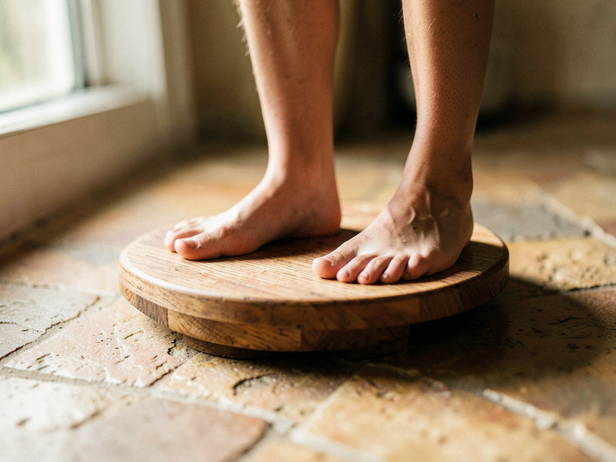
![Bare Feet on Balance Board]()
Bare Feet on Balance Board
Image credit : AI
Strengthening intrinsic foot muscles for better arch support. A mindful moment of balance.
Who Should Think Carefully Before Choosing
Arch support is not suitable for everyone. People with certain types of overpronation may find that rigid support shifts stress to the knee or hip rather than relieving it. Those with sensory neuropathy need careful monitoring, because reduced sensation means pressure problems can go unnoticed. Anyone whose foot pain has not been assessed by a physiotherapist or orthopaedic specialist is making an educated guess about which structure is actually under stress.
Strengthening programmes carry their own cautions. A foot in an acute inflammatory phase should not be loaded through a progressive exercise programme. People with connective tissue disorders that affect joint stability need guidance on which exercises are appropriate. And anyone whose pain changes character, becomes sharper, spreads, or starts appearing at rest, should stop the programme and get the foot looked at.
Neither intervention is a substitute for a clinical assessment when pain is significant, persistent, or unclear in origin. A physiotherapist can assess which muscles are underperforming, whether the arch is flexible or rigid, and whether the load pattern during walking is contributing to the problem in a way that neither insoles nor exercises alone will fix.The two approaches are not rivals. They operate on different timescales and different mechanisms. The choice between them, or the sequence in which you use both, depends on what the foot is actually doing, not on which camp has the louder advocates.
Discover expert advice and the latest updates in
Skin Care,
Hair Care,
Wellness,
Dermatology, and more at
Stay Young guide to lasting beauty and holistic health!