Compression wear sits in an odd position: it has real physiological effects, a reasonable evidence base for some uses, and a marketing layer that stretches both well past where the science stops. The honest version is more useful than the promotional one.
What Compression Actually Does to the Body
Compression garments work by applying graduated mechanical pressure to soft tissue. The pressure is highest at the periphery, the ankle in a compression sock, the wrist end of a sleeve, and decreases toward the core. This gradient matters because it assists venous return: blood moving back up through the veins toward the heart gets a mild assist from the external squeeze, reducing the pooling that happens in the lower limbs during prolonged standing or repetitive lower-body exercise.
The second mechanism is damping muscle oscillation. When a muscle contracts and then relaxes at speed, during a run or a jump, the tissue vibrates. Compression fabric limits how much the muscle belly moves with each stride. This is thought to reduce the micro-fatigue that accumulates in fast-twitch fibres over a long session, though the effect is modest and more pronounced in endurance contexts than in short, explosive ones.
What compression does not do: it does not increase the oxygen delivered to the muscle, it does not directly build strength, and it does not burn fat or reshape tissue. Claims in that territory are marketing, not mechanism.
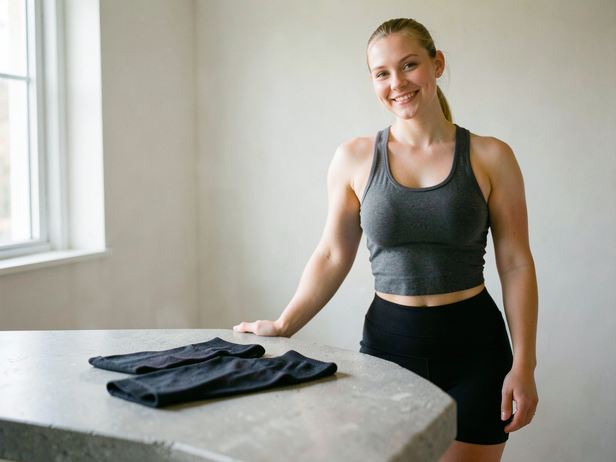
![Compression Gear & Athlete]()
Compression Gear & Athlete
Image credit : AI
Optimizing my recovery with these compression garments. Essential for post-workout compression leggings.
During Exercise: Where the Evidence Is Stronger
The clearest performance case for compression is in endurance sport, long runs, cycling, extended HIIT sessions. Reduced muscle oscillation appears to delay the perception of fatigue, which means a runner may feel less leg heaviness in the final kilometres. The effect on actual performance metrics, pace, power output, VO2 max, is small and inconsistent across studies, but the perceived exertion benefit is more reliably reported.
For resistance training, the picture is murkier. Some lifters find compression shorts or sleeves useful for proprioception, the sense of where the limb is in space, which can support form under load. Others find the restriction uncomfortable. Neither effect is large enough to be a deciding factor for most people.
Compression is not suitable for everyone during exercise. People with peripheral arterial disease, certain clotting disorders, or compromised circulation should not use compression garments without medical clearance, because external pressure on already-restricted vessels can worsen flow rather than assist it.
After Exercise: Recovery and the Swelling Question
Post-exercise is where compression has its strongest practical argument. After intense lower-body training, fluid shifts into the interstitial space around the muscle, this is part of the normal inflammatory response that drives adaptation, but it also causes swelling, stiffness, and delayed onset muscle soreness. Compression applied in the hours after exercise assists lymphatic drainage and limits how much fluid accumulates in the tissue.
The practical result: reduced swelling in the limb, and some evidence of lower perceived soreness at the 24- to 48-hour mark. This does not mean the adaptation is blocked, the compression is acting on the fluid mechanics, not on the signalling cascade that tells the muscle to rebuild stronger. Recovery compression garments are typically worn for one to two hours post-session, or overnight for endurance athletes after a very long effort.
One thing to watch: compression worn too tightly, or for too long without breaks, can restrict lymphatic flow rather than assist it. The garment should feel firm but not painful, and the skin should not show deep indentation marks when it is removed.
Fit, Fabric, and What to Actually Look For
The compression level matters more than the brand. Garments are rated in millimetres of mercury (mmHg), the same unit used for blood pressure. Mild compression, in the range of 15 to 20 mmHg, is appropriate for most exercise and recovery use. Medical-grade compression, above 30 mmHg, is prescribed for clinical conditions and is not necessary, or appropriate, for general fitness use.
Fabric composition affects durability and moisture management but does not change the compression mechanism. A garment that loses its elasticity after a few washes is no longer delivering the stated pressure, regardless of what the label originally said.
Fit is the most important variable. A compression garment that is too loose provides no mechanical benefit. One that is too tight restricts rather than assists. The right fit applies even, firm pressure along the full length of the garment with no rolling at the edges and no bunching behind the knee or at the ankle.
Compression wear earns its place in a training kit when the use case matches the mechanism: endurance sessions where muscle fatigue accumulates over time, and the recovery window after hard lower-body work. Used for those purposes, with a garment that actually fits, it does something real. Used as a general performance enhancer or a passive body-shaping tool, it does not.
Discover expert advice and the latest updates in
Skin Care,
Hair Care,
Wellness,
Dermatology, and more at
Stay Young guide to lasting beauty and holistic health!