Most people notice dry mouth as a discomfort, a sticky feeling, trouble swallowing, a thirst that water does not quite fix. What they rarely notice is the structural damage accumulating in the background. Saliva is not a passive lubricant. It is an active defence system, and when it fails, teeth and gums pay the price in ways that are largely irreversible.
What Saliva Actually Does
Saliva is produced by three pairs of major glands, the parotid, submandibular, and sublingual, plus hundreds of minor glands scattered across the mouth's lining. A healthy adult produces roughly 0.5 to 1.5 litres per day, though this varies considerably and drops significantly during sleep.
Its first job is mechanical: the flow physically washes food particles and bacteria away from tooth surfaces and into the digestive tract. Its second job is chemical. Saliva is mildly alkaline, which means it neutralises the acids produced when oral bacteria break down carbohydrates. Every time you eat, your mouth's pH drops; saliva brings it back up. The third job is remineralisation. Saliva is saturated with calcium and phosphate ions, and it uses them to repair the microscopic mineral loss that acid causes on enamel throughout the day. Enamel does not grow back once it is lost in bulk, but this constant small-scale repair prevents minor acid damage from progressing into structural loss.
Saliva also contains proteins, including immunoglobulin A, lysozyme, and lactoferrin, that limit the growth of bacteria associated with decay and gum disease. This is not a complete antimicrobial barrier, but it meaningfully shifts the balance of the oral microbiome toward less harmful species.
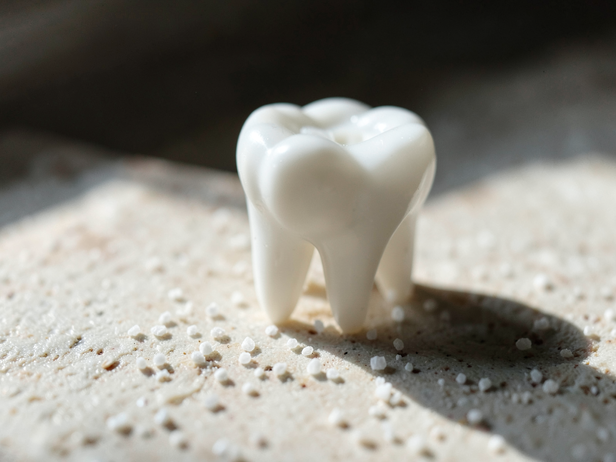
![Tooth Model and Minerals]()
Tooth Model and Minerals
Image credit : AI
Examining the effects of dry mouth on teeth, highlighting the importance of saliva.
What Happens When Saliva Drops
Dry mouth, or xerostomia, is not a disease in itself, it is a symptom, and its causes matter because the treatment differs depending on the source.
The most common cause in India's adult population is medication. Antihistamines, antidepressants, antihypertensives, diuretics, and anticholinergic drugs all reduce salivary output as a side effect. This is worth knowing because the dry mouth in these cases is ongoing, not occasional, and the dental consequences accumulate over years of use. Autoimmune conditions, particularly Sjögren's syndrome, attack the salivary glands directly and can reduce output severely. Radiotherapy to the head and neck region can cause permanent gland damage. Mouth breathing, whether from a deviated septum, allergies, or habit, produces a milder but chronic version of the same problem.
When saliva is reduced, the acid-clearing and remineralising functions slow or stop. Decay tends to appear in locations that are unusual for someone with normal saliva: along the gumline, at the tips of the lower front teeth, and on smooth surfaces that would ordinarily be well-protected. Gum inflammation becomes harder to control. Oral thrush, a fungal infection caused by Candida, becomes more likely because the antifungal proteins in saliva are no longer present in adequate concentrations. Denture wearers experience particular difficulty because saliva is also what creates the adhesive film that keeps a denture seated.
Why This Matters for Enamel Specifically
Enamel is the hardest tissue in the body, but it has no living cells and cannot repair itself once the damage exceeds what remineralisation can address. The mineral loss from a dry mouth environment is not dramatic on any single day, it is cumulative. A person whose saliva has been reduced by medication for three years may present with decay patterns their dentist finds puzzling until the medication history is taken.
Fluoride becomes more important in this context, not less. Fluoride toothpaste and fluoride mouthwashes work partly by substituting into the enamel crystal structure in a way that makes it more acid-resistant. In a low-saliva environment, using fluoride consistently becomes one of the few remaining lines of defence. This is something a dentist can advise on specifically, since the appropriate fluoride concentration and frequency depends on the severity of the dry mouth and the individual's decay history.
What Is and Is Not Worth Trying
Sipping water frequently helps with comfort but does not replicate saliva's buffering or remineralising functions. Sugar-free chewing gum containing xylitol stimulates saliva flow mechanically and has reasonable evidence behind it for people whose glands are still capable of producing saliva, it will not help where the glands themselves are damaged.
Saliva substitutes, sprays and gels available at pharmacies, provide short-term lubrication. Some contain calcium and phosphate compounds designed to partially mimic saliva's remineralising role. They are useful for comfort and for people who cannot produce saliva at all, but they are not a substitute for addressing the underlying cause.
Breathing through the nose rather than the mouth, staying hydrated, and reducing caffeine and alcohol, both of which reduce salivary output, make a measurable difference for mild cases. For medication-induced dry mouth, a conversation with the prescribing doctor about whether an alternative drug with fewer anticholinergic effects is appropriate is worth having. That is not a decision to make unilaterally.
Dry mouth that has persisted for more than a few weeks, or that is accompanied by difficulty swallowing, changes in taste, or recurring oral infections, needs clinical assessment. The cause determines the path forward, and some causes, autoimmune conditions, gland tumours, and radiation damage among them, require specialist input that goes well beyond a dentist's scope alone.Saliva is one of those systems the body runs silently until it cannot. The teeth it was protecting do not announce the loss immediately. By the time the decay appears, the protection has been absent for a long time.
Discover expert advice and the latest updates in
Skin Care,
Hair Care,
Wellness,
Dermatology, and more at
Stay Young guide to lasting beauty and holistic health!