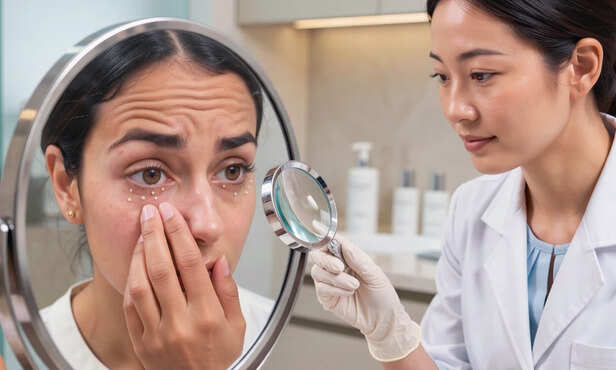
Milia are small, dome-shaped keratin cysts that form just beneath the skin surface. Unlike a whitehead, which sits inside a follicle with an opening, a milium is enclosed in its own sac with no exit channel. That distinction is not cosmetic trivia, it is the reason every squeezing attempt ends with red, irritated skin and the bump exactly where it was.
What Milia Actually Are
![under eye]()
under eye
Keratin is the structural protein that makes up skin cells, hair, and nails. As the outermost skin cells shed, they normally flake off. When that shedding process stalls, due to sun damage to the skin's surface, thick occlusive products, or simply the way the skin in that area renews itself, dead cells can become trapped and compact into a small cyst. The result is a firm, pearlescent white or yellowish bump, typically one to two millimetres across, sitting in the superficial dermis or at the dermal-epidermal junction.
The skin around the eyes is thinner than almost anywhere else on the face, and it has fewer sebaceous glands. That combination means the normal desquamation process, the orderly shedding of dead cells, is more easily disrupted here. This is why milia cluster at the inner corners of the eyes, along the lower lash line, and on the upper cheeks just below the orbital rim.
Primary milia form spontaneously and are common in adults who use heavy eye creams or who have had significant sun exposure over the years. Secondary milia develop after the skin has been injured, after a burn, a blister, a dermabrasion, or prolonged use of a topical steroid that has thinned the skin. The distinction matters because secondary milia often resolve once the underlying cause is removed, while primary milia are more persistent.
Why Squeezing Does Not Work
A whitehead has a follicular opening. Pressure applied to either side of it can expel the contents. A milium has no such opening. The keratin plug is enclosed in a complete sac, and the overlying skin is intact. Pressing against it compresses the surrounding tissue, causes localised inflammation, and risks post-inflammatory hyperpigmentation in the thin periorbital skin, but the cyst itself remains undisturbed.
Attempting to pierce it with a pin at home carries a different set of risks. The eye area is not sterile, depth control with a pin is unreliable, and the superficial dermis in this zone scars readily. A botched attempt can leave a small but permanent mark in an area where marks are highly visible.
What Actually Removes Them
A dermatologist or trained aesthetician removes milia by making a tiny incision with a sterile lancet, then expressing the keratin sac intact. The procedure takes seconds per bump, causes minimal discomfort, and leaves no lasting mark when done correctly. This is an in-clinic procedure; it is not something a facial or extraction service can reliably replicate, because the incision requires precision and sterile technique.
Some dermatologists use a fine electrocautery needle or, less commonly, a laser to open the overlying skin before extraction. The method depends on the depth of the cyst, the number of lesions, and the practitioner's preference. None of these approaches is appropriate for home replication.
Topical retinoids, prescription tretinoin or, at lower concentrations, over-the-counter retinol, can accelerate surface cell turnover and may help prevent new milia from forming. They do not dissolve existing cysts. For someone prone to recurrence, a retinoid used consistently in the periorbital area (applied carefully, given the skin's sensitivity) can reduce the rate of new formation over months. This is a preventive strategy, not a treatment for existing bumps.
Exfoliating acids such as glycolic or lactic acid work at the surface level and can support the same turnover goal, but they are unlikely to shift an established milium on their own.
When to Leave Them Alone
Milia are benign. They carry no health risk, do not become infected, and in some cases resolve on their own over weeks to months, particularly in younger adults whose skin turnover is faster. If the bumps are not bothering you, no intervention is required. A dermatologist is worth seeing if the milia are numerous, if they are growing, if they are painful or inflamed, which is unusual and warrants ruling out another condition, or if you want them removed without risking a scar from a home attempt.
One category of people for whom caution is especially warranted: anyone who has used a topical steroid around the eyes for an extended period. Secondary milia in this context may be accompanied by skin thinning, and any extraction or resurfacing approach needs to account for that fragility. A dermatologist familiar with the full history of the skin is better placed to make that call than a general extraction service.
Milia are a structural problem with a structural solution. The keratin is trapped because there is no exit, and the only reliable way to give it one is to create it under controlled conditions. Everything else, squeezing, picking, hot compresses, works around that fact rather than addressing it.
Discover expert advice and the latest updates in
Skin Care,
Hair Care,
Wellness,
Dermatology, and more at
Stay Young guide to lasting beauty and holistic health!