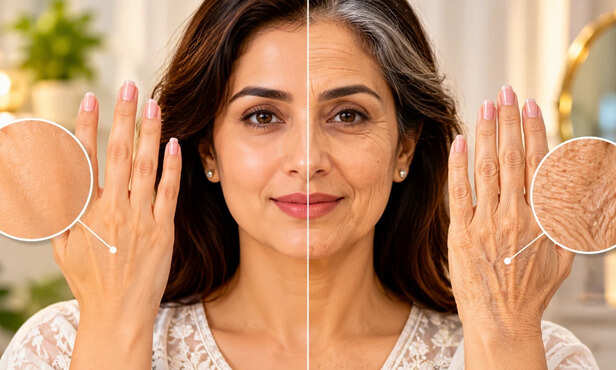
Most people notice it in a photograph first: the face looks one age, the hands look another. The gap is not vanity, it reflects genuine differences in tissue composition, fat distribution, and cumulative exposure that make these two areas age along entirely separate timelines.
The anatomy underneath is not the same
![Why Do Your Hands Age Faster Than Your Face?]()
Why Do Your Hands Age Faster Than Your Face?
Your face and hands may experience ageing differently. From sun exposure and collagen loss to frequent washing and environmental damage, discover why your hands can reveal signs of ageing sooner than your face.
The face sits over a layered architecture: bone, periosteum, several distinct fat compartments arranged in pockets, muscle, and then skin. These fat pads, the malar fat pad under the cheekbone, the deep medial cheek fat, the buccal fat pad, provide structural volume. As they thin and shift downward with age, the overlying skin follows. The face ages partly because its scaffolding relocates.
The back of the hand has almost none of this. The skin sits directly over tendons, veins, and a thin layer of subcutaneous fat that depletes significantly over time. There are no fat compartments to redistribute, the volume simply goes. Tendons and veins that were invisible at thirty become prominent at forty-five not because they have grown, but because the tissue cushioning them has thinned.
Why the face holds moisture better
Sebaceous glands, the oil-producing glands attached to hair follicles, are densely concentrated on the face, particularly around the nose, forehead, and chin. Their output declines with age, but the face starts with a high baseline. The back of the hand has very few sebaceous glands. The palmar side of the hand has none at all.
This matters because sebum contributes to the skin's lipid barrier, the layer that slows transepidermal water loss. A face with active sebaceous glands retains moisture more effectively than the dorsum of the hand, which depends almost entirely on external moisturisation to compensate for what it cannot produce. Repeated hand washing, which strips the limited lipid barrier that does exist, accelerates this dryness cycle. The skin on the back of the hand becomes thinner and more crepey partly because it is chronically under-moisturised relative to the face.
Cumulative sun exposure and where it lands
The face receives UV exposure even on overcast days and even indoors near windows, because people rarely leave the house without some awareness of it. Over decades, this adds up, but so does protection. SPF application to the face has become routine for a significant portion of the population in a way that hand application has not.
The hands, particularly the dorsum, receive direct UV exposure every time someone drives, walks, or sits near a window without thinking about it. UVA radiation, the wavelength that penetrates glass, degrades collagen and elastin in the dermis and triggers melanocyte activity, producing the pigmentation irregularities commonly called sun spots or age spots. These are not a cosmetic quirk; they are a marker of cumulative UV damage to the dermis. The hands accumulate this damage with almost no protection applied consistently over a lifetime.
The collagen and elastin picture
Both the face and the hands lose collagen and elastin with age, this is a systemic process driven by declining fibroblast activity and increased matrix metalloproteinase activity that breaks down existing collagen. The rate at which this shows depends on the starting thickness of the dermis and how much external damage has accelerated it.
Facial skin is generally thicker than the skin on the back of the hand, which gives it more reserve before structural changes become visible. The hand's thinner dermis reaches the threshold of visible laxity sooner. When elastin degrades in hand skin, the crepey texture appears earlier and with less provocation than on the face, where the thicker dermis and underlying fat pads buffer the loss for longer.
What this means practically
The asymmetry in how hands and face age is largely an asymmetry in protection applied over decades. The interventions that slow facial ageing, broad-spectrum SPF daily, a barrier-supporting moisturiser, and retinoids to stimulate fibroblast activity, work on hand skin for exactly the same reasons. The difference is that almost nobody applies them there.
A dermatologist can assess whether pigmentation on the hands warrants treatment or monitoring; some pigmented lesions on the hands require clinical evaluation rather than cosmetic intervention. For anyone concerned about the speed at which their hands are ageing relative to their face, the starting point is not a procedure, it is consistent SPF on the dorsum of both hands, every morning, including on the commute.
The face and the hands are exposed to the same years. The gap between them is mostly the gap between what gets protected and what gets forgotten.
Discover expert advice and the latest updates in
Skin Care,
Hair Care,
Wellness,
Dermatology, and more at
Stay Young guide to lasting beauty and holistic health!