Swimmers who come out of the pool with straw-like, colour-shifted hair are not imagining the damage. Chlorine and its byproducts, particularly chloramines formed when chlorine reacts with sweat and organic matter, penetrate the hair shaft, oxidise the melanin pigment, and degrade the keratin proteins that give the strand its tensile strength. The damage is cumulative, and it compounds with every session.
What Chlorine Actually Does to the Hair Shaft
![Wetting hairs]()
Wetting hairs
Chlorine is an oxidising agent. When it contacts the hair, it first attacks the cuticle, the overlapping scale-like cells that form the outer layer of the shaft. Once those scales are lifted or eroded, chlorine reaches the cortex, where melanin granules sit and where the structural keratin bonds are. Oxidation of melanin produces lighter pigments, which is why frequent swimmers often see their colour shift toward orange or green tones. The green is more accurately caused by copper compounds in pool water binding to the protein in damaged hair, not chlorine itself. Chlorine degrades the disulfide bonds in keratin and strips the lipid layer on the cuticle surface, leaving strands porous, rough to the touch, and prone to breakage. Hair that is already chemically processed, coloured, bleached, or permed, has a compromised cuticle to begin with, making it significantly more vulnerable.
Why Pre-Wetting Works
Hair is porous. Dry hair absorbs liquid readily, and when you enter a chlorinated pool, the shaft draws in pool water to reach saturation. If the hair is already saturated with plain water before you enter the pool, it has less capacity to absorb chlorinated water. This is the pre-wet principle: it does not block chlorine entirely, but it meaningfully reduces uptake by occupying the absorption space first. The practical version is straightforward, wet your hair thoroughly at the poolside shower before entering the water. This takes about 30 seconds and works better than any cap alternative for people who swim without one. For an added layer of protection, applying a small amount of a leave-in conditioner or a light oil such as coconut or argan oil before wetting creates a partial physical barrier on the cuticle surface. The oil does not waterproof the strand, but it slows the rate at which water, and the chlorine dissolved in it, is absorbed.
Who Needs to Be More Careful
The pre-wet trick reduces chlorine uptake for everyone, but the baseline risk varies. People with colour-treated or bleached hair have a cuticle that is already more open, so chlorine penetrates faster and the oxidative damage accumulates more quickly. Fine hair, which has a higher surface-area-to-volume ratio, tends to show damage sooner than coarser hair. Those with androgenetic hair loss or telogen effluvium, where the hair is already in a fragile or shedding phase, are not at higher risk of losing more hair from chlorine exposure specifically, but the structural weakening of existing strands can make breakage more visible. Chlorine does not cause or worsen androgenetic pattern hair loss, which is driven by dihydrotestosterone sensitivity at the follicle level. It is worth being clear on that distinction: chlorine is a shaft problem, not a follicle problem. It damages the strand you can see, not the root that produces the next one.
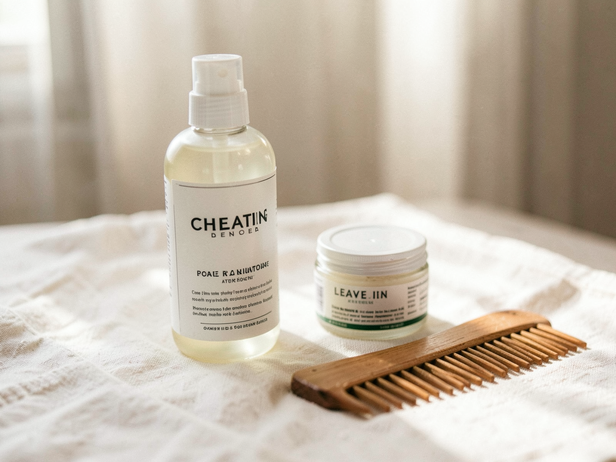
![Haircare Essentials for Swimmers]()
Haircare Essentials for Swimmers
Image credit : AI
My routine for combating pool chlorine hair damage includes this essential haircare duo and comb.
After the Pool: What Actually Helps
Rinsing hair with plain water immediately after swimming removes a significant proportion of the chlorine sitting on the surface before it has time to continue reacting. This is the second most important step after pre-wetting. A clarifying or chelating shampoo used once or twice a week will remove chlorine and mineral buildup that regular shampoo leaves behind, these are formulated to break the bond between mineral deposits and the hair shaft rather than simply washing over them. A protein-based conditioner used after swimming sessions helps temporarily restore some of the structural integrity the shaft loses through oxidation, though it is a repair measure, not a reversal. The cuticle damage from repeated chlorine exposure does not fully repair itself; the goal is to slow the rate of accumulation and support the shaft between sessions. If you swim daily and are seeing significant breakage or texture change, a dermatologist or trichologist can assess whether the damage is primarily environmental or whether an underlying hair or scalp condition is making strands more susceptible.
Discover expert advice and the latest updates in
Skin Care,
Hair Care,
Wellness,
Dermatology, and more at
Stay Young guide to lasting beauty and holistic health!